If you’ve been reading comics online for a while, you’ve probably seen these three words a lot:
Manga vs Manhwa vs Manhua
At first, they can all seem like the same thing.
They all involve illustrated stories.
They all have a lot of genres.
They all have fans who will absolutely recommend you “just one more title” until suddenly your reading list is out of control. 😂
But even though they’re closely related, they’re not exactly the same.
The biggest difference starts with where they come from, but it doesn’t stop there.
Once you start reading more, you’ll notice differences in the way the pages are laid out, how the stories are paced, whether they’re usually in color or black and white, and even how you actually read them.
Manga often feels more traditional and page-based.
Manhwa usually feels more modern and made for scrolling.
Manhua can feel similar to manhwa at first, but it often brings its own style, settings, and storytelling influences.
And honestly, the more you read, the easier it becomes to tell them apart without even thinking about it.
You also start noticing that certain genres seem to show up more often in one format than another.
That’s part of the fun.
You don’t really have to choose just one.
If you’re new to this side of reading, or if you’ve always been curious about what separates one from the other, here’s a simple breakdown of the differences between manga, manhwa, and manhua.

They’re Similar, But They Come From Different Places
The easiest way to understand it is this:
- Manga = Japan
- Manhwa = Korea
- Manhua = China
That’s the most basic difference.
All three are forms of illustrated storytelling, but they come from different countries, different publishing traditions, and often slightly different reading styles.
That said, once you get deeper into them, you’ll start noticing that the differences are not just about geography.
The format, art style, reading direction, and even the feel of the storytelling can be a little different too.
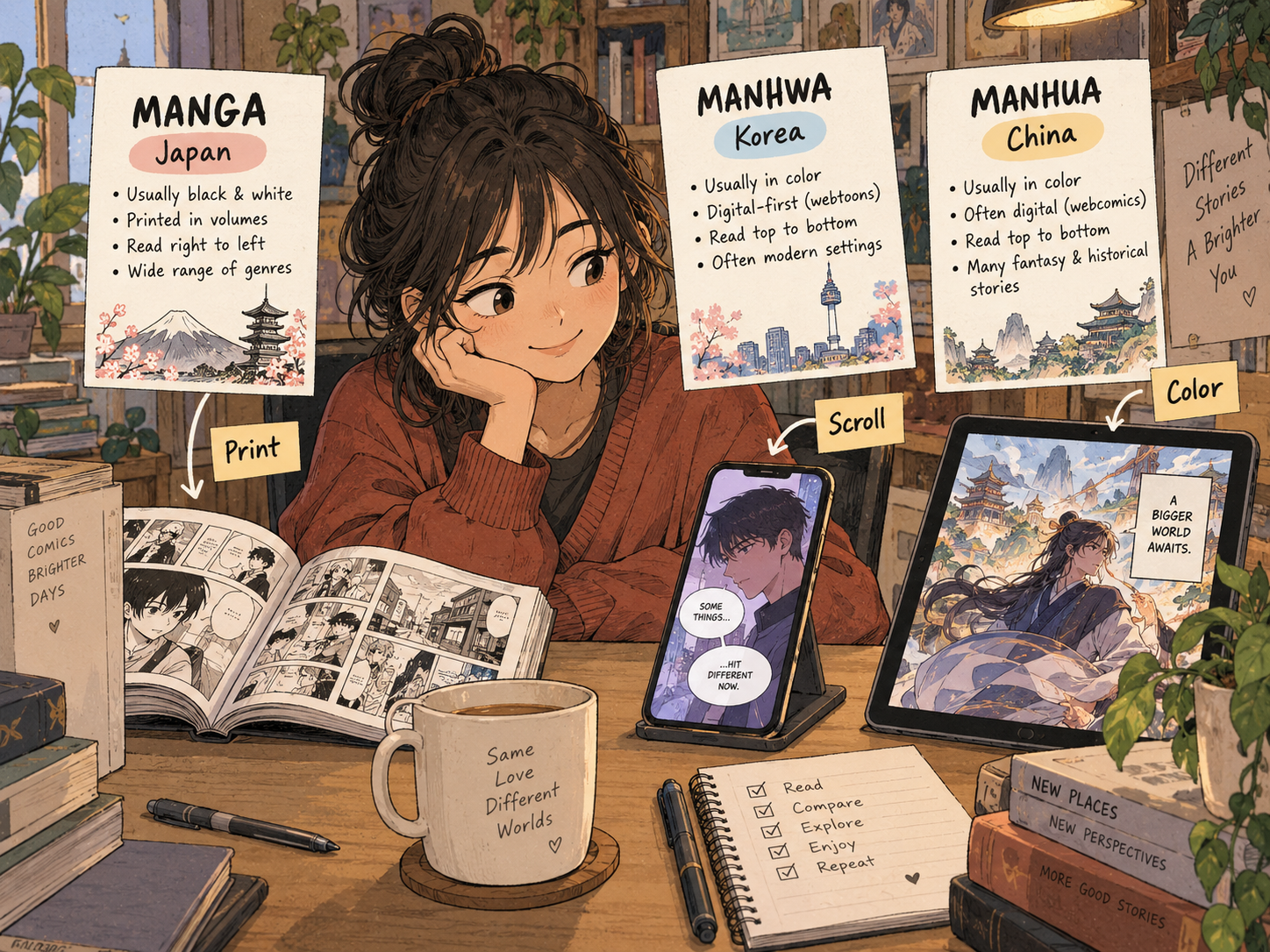
For example, manga is still strongly connected to the traditional printed comic format. A lot of manga is black and white, divided into pages and panels, and usually read from right to left.
Manhwa, especially the kind most people read online today, often feels much more built for phones. You scroll vertically, the artwork is usually in full color, and the spacing between panels can be used to build suspense or make a scene feel more dramatic.
Manhua can sometimes feel similar to manhwa because a lot of it is also published digitally and in full color. But the stories, settings, character designs, and themes can feel very different depending on what you’re reading.
You’ll also notice that certain genres seem to be more common in one than another.
Manga has pretty much everything.
Manhwa has become huge for things like hunters, systems, regression, reincarnation, and murim.
Manhua, on the other hand, has a lot of cultivation, martial arts, historical fantasy, and stories with really massive power scaling.
Of course, these aren’t strict rules.
There are always exceptions.
But once you read enough of each, you’ll start noticing the differences naturally.
You might even reach a point where you can look at a few panels and think:
“Yeah, this definitely feels like manhwa.” 😂.
What Is Manga?
Manga refers to comics or graphic stories from Japan.
This is probably the one most people are already familiar with.
If you’ve ever read titles like One Piece, Naruto, Attack on Titan, Death Note, or Berserk, then you’ve already read manga.
Traditionally, manga is:
- Usually black and white
- Often released in chapters and later collected into volumes
- Read from right to left
- Very closely tied to print culture
That last part is a big one.
Even though manga is now widely read online too, it still has a strong print identity. You can feel it in the page layouts, paneling, pacing, and how scenes are designed to be read page by page.
For me, manga still has that classic feel.
There’s something nice about turning the page and letting the panels guide you the way they were originally intended.
What Makes Manga Stand Out?
One of the strengths of manga is how broad it is.
There’s pretty much something for everyone:
- Action
- Fantasy
- Romance
- Slice of life
- Horror
- Sports
- Mystery
- Sci-fi
- Comedy
And because manga has been around for so long, it also has some of the most iconic series in comics.
It’s the kind of medium where you can go from something as chaotic as Chainsaw Man to something emotional, funny, dark, relaxing, or completely ridiculous, depending on what you’re in the mood for.
That variety is probably one of the biggest reasons manga has stayed so popular for so long.
You can read something intense like Attack on Titan, switch to a sports series, then move on to a romance or slice-of-life story without ever leaving the same medium.
There are also so many different art styles and storytelling approaches.
Some manga are very detailed and serious.
Others are simple, funny, and easy to read.
And some start out looking lighthearted, then suddenly hit you with a story that gets way deeper than you expected.
That’s part of what makes manga fun.
You can almost always find something that matches your mood.
What Is Manhwa?
Manhwa refers to comics from Korea.
These days, when most people say manhwa, they’re often talking about Korean webcomics, especially the ones published in the webtoon style.
And this is where things start to feel different from manga.
Manhwa is commonly:
- Full color
- Designed for digital reading
- Read top to bottom
- Often built in a vertical scroll format
So instead of flipping pages or reading panel by panel across a page, you’re usually just scrolling down on your phone.
That format changes the whole reading experience.
Scenes can feel more cinematic.
Reveals can feel more dramatic.
And cliffhangers somehow hit harder when you’re forced to keep scrolling. 😂
Another thing I like about manhwa is how easy it is to read casually.
You don’t need to sit down with a physical volume. You can open your phone, read a few chapters, stop, then come back later.
Of course, “a few chapters” can easily turn into 30 if the story is good enough.
The artwork also tends to feel very clean and modern, especially with the use of color, lighting, and longer vertical panels.
That format works really well for action scenes, dramatic reveals, and those moments where the main character suddenly shows everyone how overpowered they actually are.
And yes, I’m a big fan of that kind of story. 😂
If you’ve read Solo Leveling, Tower of God, Omniscient Reader’s Viewpoint, or The Greatest Estate Developer, then you’ve already seen how different manhwa can feel compared to traditional manga.point, or The Greatest Estate Developer, then you already know the manhwa style pretty well.
What Makes Manhwa Stand Out?
For me, one of the biggest strengths of manhwa is how easy it is to binge.
The vertical format feels super natural, especially on mobile.
And visually, the full color makes it more immediately eye-catching.
A lot of manhwa also has a very strong grip on genres that I personally enjoy a lot, like:
- Regression
- Reincarnation
- Murim
- Hunter/system stories
- Overpowered main characters
- Dungeon-style fantasy
Basically, if you enjoy watching a weak character become ridiculously broken after 20 chapters, manhwa will probably keep you busy for a long time. 😂
What makes it even more addictive is the pacing.
A lot of manhwa knows exactly when to end a chapter on a cliffhanger, so you keep telling yourself, “Okay, just one more.”
Then one more becomes five.
Then five becomes 20.
And suddenly it’s way past the time you were supposed to sleep.
I also like how satisfying the progression can be. You get to watch characters improve, unlock new abilities, beat enemies that used to be impossible, and slowly become stronger as the story moves forward.
Of course, not every manhwa follows the same formula, but these kinds of stories are definitely a big reason I keep coming back.
The art also plays a huge role.
Because most manhwa is in full color, action scenes can look really impressive, especially when the artist uses lighting, effects, and long vertical panels to make certain moments feel bigger.
Sometimes you already know the main character is going to win.
You’re just reading because you want to see how badly everyone else is about to lose. 😂
And honestly, that’s completely fine.
Not every story has to be unpredictable to be enjoyable.
Sometimes you just want something fun, easy to binge, and satisfying to read.
What Is Manhua?
Manhua refers to comics from China.
Like manhwa, manhua is also often read digitally, and a lot of it appears in full color.
It’s also commonly read top to bottom, especially in webcomic format.
So if you’re comparing manhwa and manhua at first glance, they can seem more similar to each other than either does to manga.
But once you’ve read enough of them, you start noticing some common manhua traits.
A lot of manhua leans heavily into genres such as:
- Fantasy
- Historical stories
- Martial arts
- Cultivation
- Romance
- Adventure
One thing that stands out to me is how manhua can go really big with its worlds.
You’ll often see huge sects, powerful families, ancient techniques, spiritual energy, legendary weapons, and characters constantly trying to become stronger than everyone around them.
If you enjoy stories where the power scale just keeps climbing, manhua can be really fun.
Some series also have a very different atmosphere compared to manhwa, especially when they lean into traditional Chinese settings, mythology, martial arts, and cultivation.
And yes, some of them can get a little complicated.
There can be a lot of names, ranks, clans, and power levels to remember.
But once you get used to it, that’s part of the charm.
If you’ve heard of titles like Tales of Demons and Gods, The King’s Avatar, Battle Through the Heavens, or Heaven Official’s Blessing, then you’ve already stepped into manhua territory.tivation arcs, or historical aesthetics, manhua has a lot to offer.
So What’s the Main Difference?
If I had to simplify it as much as possible, I’d say this:
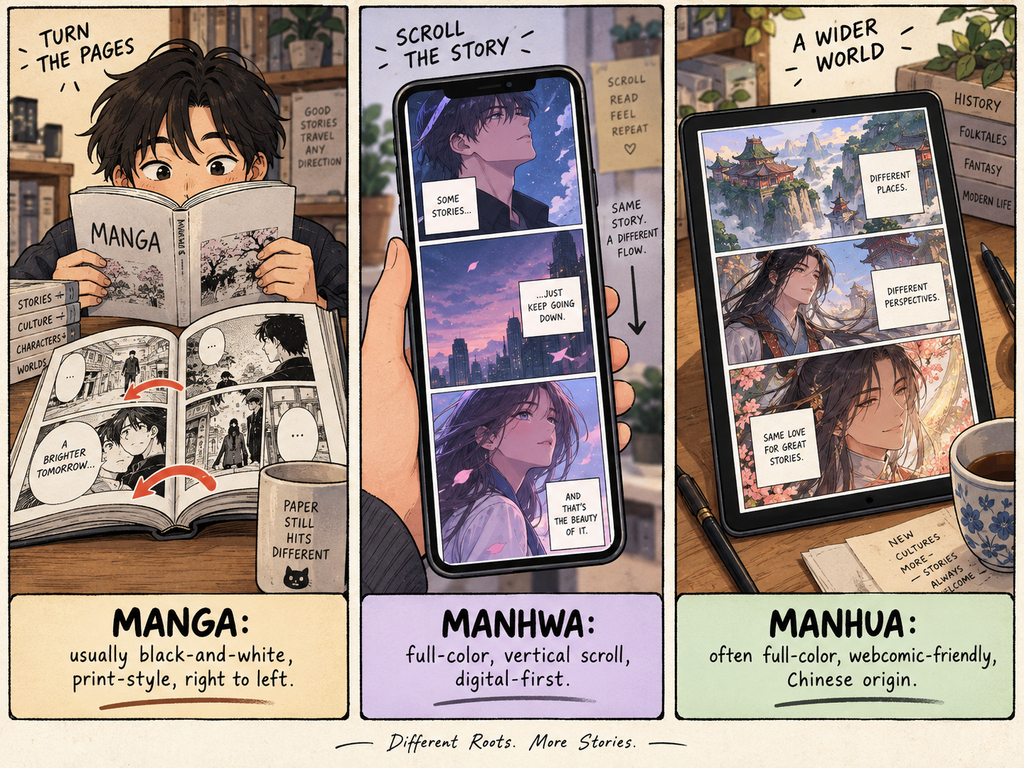
- Manga feels more tied to print, usually black and white, and traditionally read right to left
- Manhwa feels more tied to webtoon/digital reading, usually in full color and vertical scroll format
- Manhua is also often digital and full color, but comes from China and often has its own storytelling trends, especially in fantasy, martial arts, and historical genres
That’s the easiest way to remember it.
Once you start reading more of each, the differences become much easier to notice.
Sometimes it’s the layout.
Sometimes it’s the art.
Sometimes it’s just the way the story moves.
Manga can feel more structured around pages and panel turns, while manhwa often feels smoother on a phone because everything is designed around scrolling. Manhua can sometimes look similar to manhwa at first, but the setting, character names, themes, and worldbuilding usually start to give it away.
You’ll also notice that the experience can change depending on where you read them.
A physical manga volume feels completely different from scrolling through a manhwa chapter on your phone late at night.
And that’s part of what makes all three interesting.
They may all fall under the same general world of comics, but they each bring something different to the table.
Of course, there are exceptions.
Not every manga is black and white forever.
Not every manhwa looks the same.
Not every manhua follows one specific formula.
But as a general guide, that’s a good starting point.
Which One Is Better?
I personally lean more toward manhwa.
The full-color art, vertical scrolling, and the kinds of stories it usually does well just fit what I enjoy reading more.
I’m especially into regression, murim, hunter systems, dungeon stories, and overpowered main characters, so manhwa naturally ends up being the one I read the most.
But that’s just my preference.
Some readers prefer manga because of the page structure, the history, and the huge variety of iconic titles.
Some prefer manhua because they enjoy Chinese fantasy, cultivation stories, martial arts, and that bigger, more dramatic style.
So I don’t really look at it as one being objectively better than the others.
For me, manhwa is probably my favorite, but it really comes down to what kind of stories you enjoy.
At the end of the day, they all give you more stories to discover, and that’s probably the best way to look at it.
Where Should You Start?
If you’re new and wondering where to begin, here’s a simple way to think about it.
Start with manga if you want:
- Classic, iconic series
- Traditional comic page layouts
- Huge genre variety
- A strong print-reading feel
Good starting titles:
- Death Note
- One Piece
- Attack on Titan
- Demon Slayer
Start with manhwa if you want:
- Easy mobile reading
- Full-color art
- Fast-paced modern storytelling
- Overpowered MCs, systems, hunters, regression, or murim
Good starting titles:
- Solo Leveling
- Omniscient Reader’s Viewpoint
- Tower of God
- The Greatest Estate Developer
Start with manhua if you want:
- Cultivation
- Martial arts
- Historical or fantasy-heavy settings
- Big worlds and dramatic power scaling
Good starting titles:
- Tales of Demons and Gods
- The King’s Avatar
- Battle Through the Heavens
- Heaven Official’s Blessing
My Personal Take
For me, one of the best things about reading now is that you don’t really have to limit yourself to one format.
You can read manga when you want something classic and page-based.
You can read manhwa when you want to scroll endlessly at 1 a.m. even though you told yourself you were only reading one chapter.
And you can read manhua when you want to dive into something bigger, wilder, or more fantasy-heavy.
They each have their own strengths.
Sometimes I’m in the mood for the slower, page-by-page feel of manga. Other times, I want something fast and easy to binge on my phone, which is where manhwa usually wins for me.
Then there are days when I just want a story with crazy power levels, martial arts, cultivation, or a huge fantasy world, and that’s usually when manhua comes in.
That’s the nice part about having all three.
You don’t really have to pick a side.
You can just read whatever matches your mood at the time.
And once you stop thinking in terms of “which one is best?” and start thinking in terms of “what kind of story am I in the mood for?”, it becomes a lot more fun.
Final Thoughts
At the end of the day, manga, manhwa, and manhua all give us the same thing:
great stories in visual form.
They may come from different countries.
They may look different.
They may read differently.
They may lean into different genres or styles.
But they’re all part of the same bigger reading culture that a lot of us enjoy.
So whether you’re reading a black-and-white manga volume, scrolling through a colored manhwa on your phone, or getting lost in a fantasy-heavy manhua, it all comes down to one thing:
If the story is good, you’re staying.
And if you’re anything like me, your reading list is probably already too long anyway. 😂
If you’re into stories like these, you can find more of what I’m reading over on the [READ] side of Roam Play Repeat.